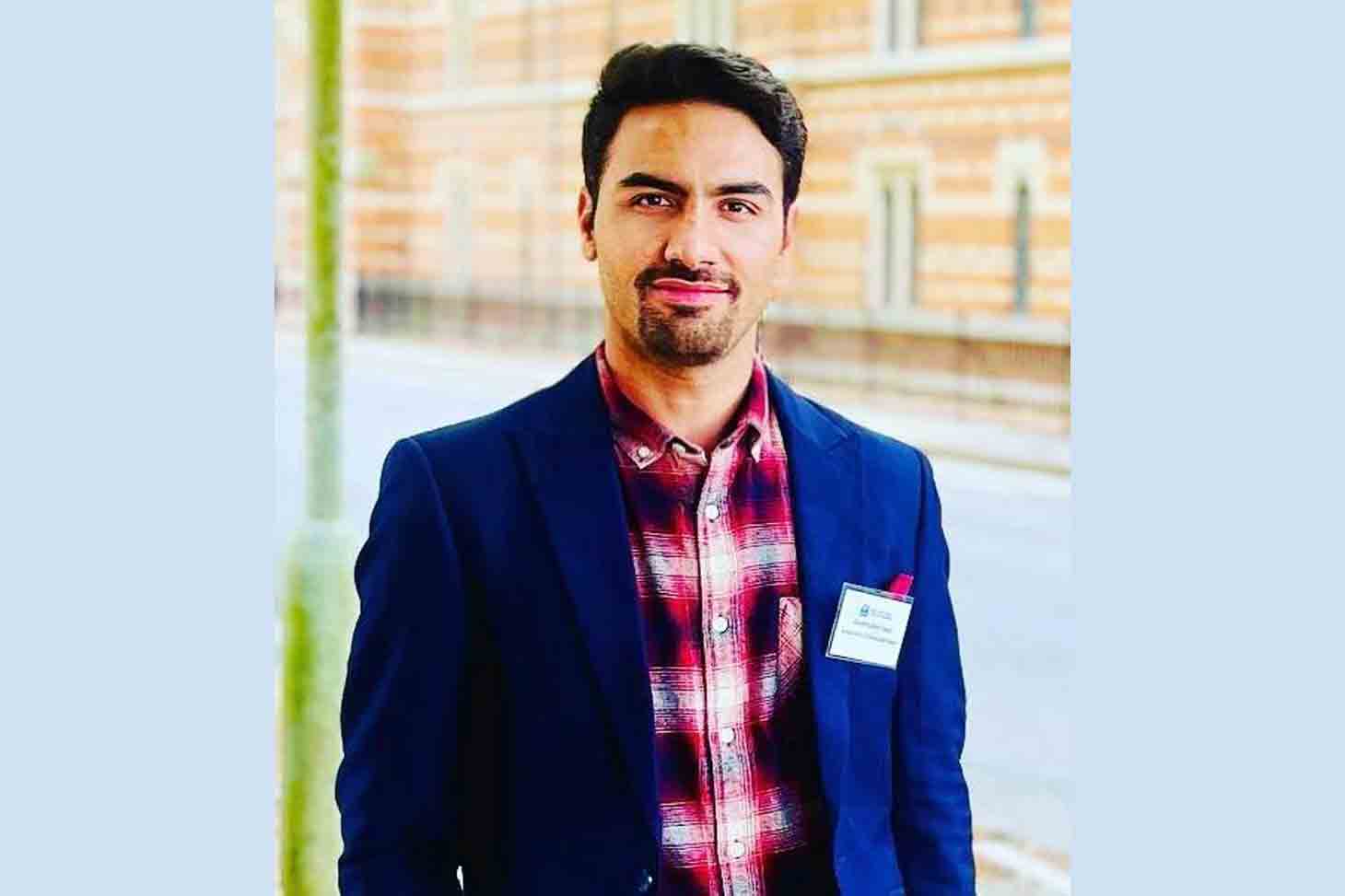
This interview highlights the remarkable academic and personal journey of Mushfiqullah Sapay, a young Afghan civil engineer who, despite political upheaval and threats to his freedom, has continued to conduct research at the highest level. His experience reflects the essential role of universities in preserving knowledge, collaboration, and human dignity.
Can you tell us about your scientific background?
My journey in civil engineering began in Afghanistan, where I graduated at the top of my high school class and earned an award at the 8th Zhautykov International Olympiad in Kazakhstan. This achievement opened the door to international educational opportunities that shaped the rest of my career.
In 2013, I was awarded two prestigious scholarships simultaneously: the Turkish government's scholarship of excellence and the Afghan government's scholarship for the top performers in university entrance exams. This enabled me to pursue a bachelor's degree in civil engineering at Yildiz Technical University in Istanbul, where I won first place in the faculty's final project competition. During my studies, I also broadened my horizons through an Erasmus exchange at Brno University of Technology in the Czech Republic.
After graduating with honors in 2016, I secured an Erasmus internship in 2017 at the L2MGC Laboratory at CY Cergy Paris University, where I worked on fiber-reinforced concrete. This experience sparked my fascination with the behavior of materials under extreme conditions—a subject that would become central to my doctoral work.
In 2018, I enrolled in a Master's degree in civil engineering atUniversité Grenoble Alpes, specializing in structural mechanics and risks. Under the supervision of Professor Pascal Forquin at the 3SR laboratory, I discovered my passion for studying the behavior of concrete under dynamic loads. Unlike many of my fellow Afghans who chose to stay in Europe, I made the difficult decision to return to Afghanistan after graduating in 2019, convinced that the knowledge I had acquired should benefit my country.
Your academic freedom has been threatened. Can you explain why?
The threats to my academic freedom stemmed from my commitment to education that empowers everyone to flourish, regardless of gender, and my belief that knowledge transcends borders. As a lecturer at Mustaqbal University in Kabul, I taught civil engineering in mixed-gender classes, which became controversial in an increasingly restrictive environment.
During my classes, I often drew inspiration from my experiences studying in Turkey, the Czech Republic, and France, describing how universities in those countries encouraged critical thinking and equal participation. For me, these were universal educational principles. However, my approach to teaching and my advocacy for inclusive education made me a target for those who opposed these values.
I began receiving warnings through various channels about my teaching methods and professional activities. My wife, who worked as an associate architect at UNOPS after studying in India, faced similar challenges in her work with international organizations. The situation became increasingly difficult when we received written warnings about our career choices and our commitment to equal opportunities in training and employment.
After the political transition in Afghanistan in August 2021, the situation became critical. Those of us who had international connections and a Western education were immediately exposed to risk. The environment became such that not only was academic freedom restricted, but our safety was also seriously threatened. We were forced to move several times, living with relatives and moving from one house to another, in difficult conditions.
What made this situation particularly difficult was having to leave behind members of our immediate family in situations over which we had no control. The decision to seek refuge abroad, knowing that our loved ones were still in danger, continues to weigh heavily on us.
You received a grant from the PAUSE program. How did you manage to secure this funding?
The awarding of the PAUSE scholarship reflects the exceptional compassion and remarkable responsiveness of the academic community atUniversité Grenoble Alpes. When the political situation in Afghanistan took a sudden turn for the worse in August 2021, I desperately tried to contact the French embassy to arrange for emergency evacuation, but the chaos and circumstances made this impossible. My wife and I had to go into hiding, regularly changing locations to ensure our safety.
During those extremely difficult weeks, my former master's director, Professor Pascal Forquin, remained in constant contact with me. He understood the gravity of our situation from my messages and was familiar with my academic background. Together with the head of the department and several faculty members, he explored every possible avenue to help us.
That's how they discovered the PAUSE program (National Emergency Reception Program for Scientists and Artists in Exile), which specifically supports researchers and academics in danger. The president ofUniversité Grenoble Alpes really involved: he reviewed our file and signed the application documents himself. The university committed to funding 40% of my doctoral program, with the PAUSE program covering the remaining 60%.
While waiting for the application to be approved, we made the difficult decision to leave Afghanistan for Iran in December 2021. A week after our arrival in Tehran, we received incredible news: we had been granted "Talent Passport" visas for France under the Pause program. We arrived in Paris on December 15, 2021, and I officially began my PhD at the 3SR laboratory in February 2022. In March 2022, France recognized us as refugees, acknowledging the legitimacy of the risks we had faced. The Pause program not only offered us safety: it allowed us to continue our academic work and contribute to the advancement of science.
What is your current research focusing on?
My research focuses on a question that is essential to infrastructure safety: how does concrete—the most widely used construction material in the world—behave when subjected to extreme dynamic loads, such as impacts, explosions, or earthquakes?
Having witnessed firsthand how vulnerable infrastructure can be to natural disasters and human conflict, I understand how laboratory research can literally save lives.
More specifically, my research focuses on three key factors influencing the dynamic tensile behavior of concrete: specimen size, water content, and loading rate. Using cutting-edge experimental techniques developed at the 3SR laboratory, such as ultra-high-speed imaging (capable of recording up to 10 million images per second) and digital image correlation, we observe how concrete fractures on a microsecond scale.
One of our most surprising discoveries challenges the conventional understanding of the material: under dynamic loading, larger concrete specimens exhibit higher tensile strength, contrary to what is observed under static conditions. We have also demonstrated that water content plays a decisive role in the propagation of cracks through the material. These results have direct implications for the design of safer infrastructure, whether bridges, dams, or protective structures in mountainous regions such as the French Alps.
This work has already resulted in two publications in leading international journals (Q1).
The first article, published in the International Journal of Impact Engineering, uses ultra-fast phase-contrast X-ray synchrotron imaging to analyze the microcracking processes of concrete under confined compression.
The second, published in Engineering Fracture Mechanics—the leading international journal in fracture mechanics—studies crack propagation speed and fracture toughness under dynamic conditions, focusing in particular on the influence of water content using two full-field measurement techniques.
Beyond publications, I had the privilege of presenting this work at high-level international conferences, notably at Oxford University (2022), where I presented experimental photomechanical methods for characterizing the cracking rate in brittle materials. I also had the opportunity to present my results at DYMAT (Aussois, 2023), MécaDymat (Toulouse, 2024), and the 8th VH Days (Grenoble, 2024), thereby strengthening scientific exchanges and collaborations within the European research community.
The Pause program is much more than just funding; it is an investment in a future where researchers at risk do not merely survive, but thrive and give back to the communities that have welcomed them.
C
How did your integration into the scientific community atUniversité Grenoble Alpes goUniversité Grenoble Alpes
Arriving in Grenoble in February 2022 was both a relief and a challenge. My wife and I were finally safe, but we also had to adapt to a new environment while dealing with the trauma of leaving our country under difficult circumstances. We had to leave behind family members in situations we wished we could change but were powerless to do so, which continues to affect us deeply. Starting a thesis under these conditions seemed overwhelming, but the scientific community at UGA quickly became an unexpected source of comfort and meaning for me.
The 3SR laboratory welcomed us with remarkable warmth and support. Professor Forquin and his team understood that integrating did not just mean having access to a laboratory, but also rebuilding a life. The university's ISSO (International Students and Scholars Office) helped us with housing, residence permits, and access to healthcare. When our son was born in November 2024, the laboratory community celebrated this event with us, seeing it as a symbol of hope after difficult times.
On the scientific front, I have found my place within the ExperDyn research group, where my colleagues consider me a full-fledged researcher, contributing valuable insights. Over the past three years, I have co-supervised eight master's students, sharing my expertise in experimental techniques while learning from their innovative approaches. Leading practical sessions in French has been a stimulating challenge: it has pushed me to perfect my command of the language while nurturing my passion for teaching.
The culture of teamwork within the laboratory was profoundly transformative. Experienced researchers generously shared their knowledge when I encountered difficulties. When I gave presentations at conferences in Oxford, Aussois, Toulouse, and Grenoble, the laboratory provided me with financial support and valuable guidance to help me improve my scientific communication skills. These experiences expanded my professional network across Europe and strengthened my sense of belonging to the international research community.
What are your plans for the future?
My immediate goal is to complete my doctoral thesis by January 2026. Beyond that, I aspire to build a sustainable academic career in France, with a particular focus on securing a position as a lecturer, which would allow me to contribute to both research excellence and education.
To strengthen my qualifications, I am continuing my teaching activities, improving my French language skills to reach a B2/C1 level—which is essential for teaching at the bachelor's degree level—and developing my publication record so that I can apply for sought-after academic positions.
My long-term research vision focuses on improving the resilience of infrastructure in the face of extreme stresses. Aging infrastructure in Europe is increasingly exposed to threats linked to climate change, and my expertise in the dynamic behavior of concrete could contribute to the development of more effective protection solutions. In particular, I would like to create a research group combining experimental approaches and advanced numerical modeling in order to address concrete engineering issues while training the next generation of specialists.
Beyond research, I am deeply committed to teaching and mentoring students. My own journey has shown me how educational opportunities can transform a life. I would like to offer these same opportunities to others, particularly students from underrepresented backgrounds or conflict-affected regions, by showing them that civil engineering can be both an intellectual adventure and a social commitment.
Although I cannot safely return to Afghanistan, I hope that one day, when peace returns, the knowledge and networks I am building today in Europe will contribute to rebuilding my country's infrastructure and educational institutions. For now, France has become our home—a place where my wife and I can raise our son Attal in safety, where academic freedom is protected, and where we can make a meaningful contribution to society through research and teaching.The PAUSE program is much more than funding: it is an investment in a future where researchers in danger do not merely survive, but thrive and give back to the communities that have welcomed them.

 ColibriSupport for students and researchers in exile