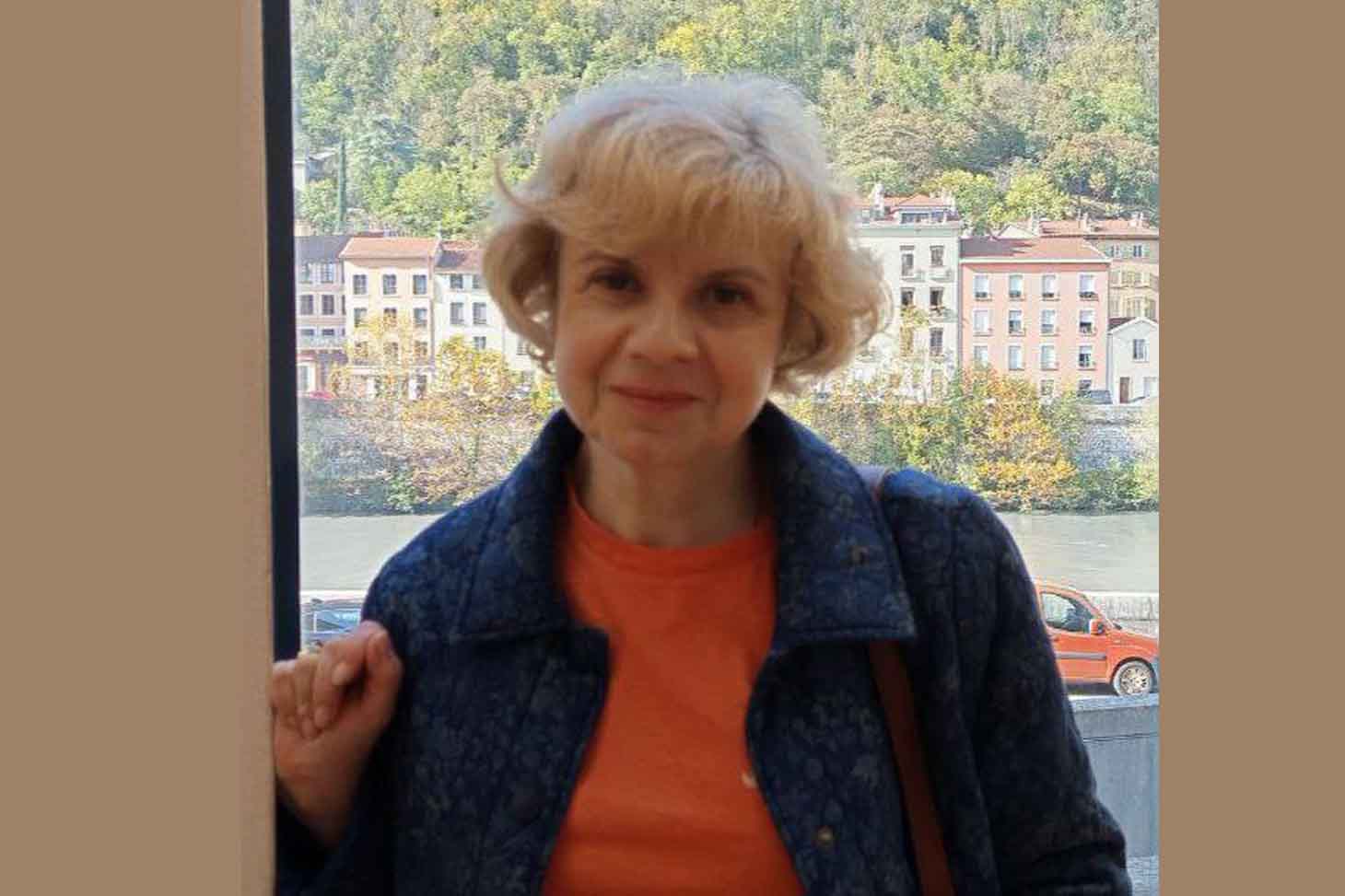
A winner of the PAUSE and GATES programs, Professor Ievgeniia Bodarenko joinedUniversité Grenoble Alpes being displaced by the war in Ukraine. In this interview, she discusses her academic career, her research on information warfare and memetics, and her integration into the UGA scientific community.
Can you tell us about your scientific background and how you came to join UGA?
I come from a family of academics. Both my grandparents were members of the Academy of Sciences, and my father is a radiation physicist at V. N. Karazin Kharkiv National University. I myself graduated from there in 1989. I defended my doctoral thesis in 2000, then my habilitation thesis in 2012.
I have always worked in the English Philology Department at this university: first as a lecturer, then as an associate professor, and finally as a full professor.
I am the author of nine monographs (individual and collective), numerous textbooks, and more than 250 scientific articles.
More recently, I arrived in Grenoble in August 2022. The PAUSE grant began in February 2023. My GATES projects will begin in February 2026 and continue until the end of June.
Your academic freedom has been threatened. Can you explain why?
I come from Kharkiv, a city that was heavily bombed from the very first minutes of the large-scale Russian invasion in 2022. Even today, as an area close to the front line, the city experiences around five to six air raid alerts per day and night, which can last four to five hours.
My parents are nearly 90 years old and couldn't take refuge in a shelter, so we had to stay at home under enemy fire. We live on the top floor, which makes it even more dangerous.
Many of my colleagues have lost their homes or loved ones. Our university has been attacked several times, and some of its buildings have been completely destroyed.
You obtained two grants, one from the PAUSE program and the other from the GATES program. How did you manage to secure these grants?
I simply did my best! More seriously, several factors probably played a role.
First, my field of research: I study the semiotic and cognitive aspects of counter-propaganda, memetics, and information warfare in times of war. In the humanities, it's hard to imagine a more topical subject.
Second, I am fortunate to belong to one of the strongest cognitive schools in my country. Finally, I have met some wonderful people in France who are full of compassion and commitment to science.
What is your current research focusing on?
My work focuses on information warfare in the media and memetics.
As part of the GATES project, I will compile a corpus of Ukrainian war memes, which will be analyzed according to their cognitive and semiotic value.
I am collaborating with a partner from Harvard Library who is involved in the SUCHO (Saving Ukrainian Cultural Heritage Online) project, which has already compiled a corpus of over 9,000 memes. Mine is more modest, but it stands out in terms of its nature and approach. We will try to coordinate our efforts.
How did your integration into the scientific community atUniversité Grenoble Alpes goUniversité Grenoble Alpes
The ILCEA4 laboratory welcomed me with open arms as soon as I arrived, even before I was officially accepted into the PAUSE program. The team allowed me to present the projects that I then implemented as part of my grant.
I am fortunate to have an exceptional mentor, Professor Caroline Rossi, who invited me to Grenoble in 2022 to start the PAUSE project. She has been—and continues to be—my guide in the academic world and in projects here.
Thanks to her, I already have many friends in Grenoble and other French cities.
At the same time, I continue to teach online at my university in Kharkiv. Under the current circumstances, the teaching load there is several times greater than at French universities. My students are scattered around the world and need more attention and support than before. This keeps me connected to my department and my students almost day and night, seven days a week.
What are your plans for the future?
You know, among many other things, the war taught me not to plan too much. The global situation is so unstable that making plans sometimes seems futile.
Of course, I long to return home, to be reunited with my colleagues who are now scattered across the globe. Time will tell.
(Incidentally, my postdoctoral thesis and two of my monographs were devoted to the concept of time). I am therefore well placed to know that he will give us the answer, sooner or later. That is certain.

 ColibriSupport for students and researchers in exile